Spherical Exoskeleton for the Measurement of Shoulder Movement
Authors: Jiaji Li, John Golden, Bailey E. Johnson, Edward Quilligan, Vance 0. Gardner, MD, Carlos A. Prietto, MD, and John Michael McCarthy
This study was presented as a presentation at the Canadian Committee for the Theory of Machines and Mechanisms (CCToMM) M3 Symposium and published in the Transactions of the Canadian Society for Mechanical Engineering Journal.
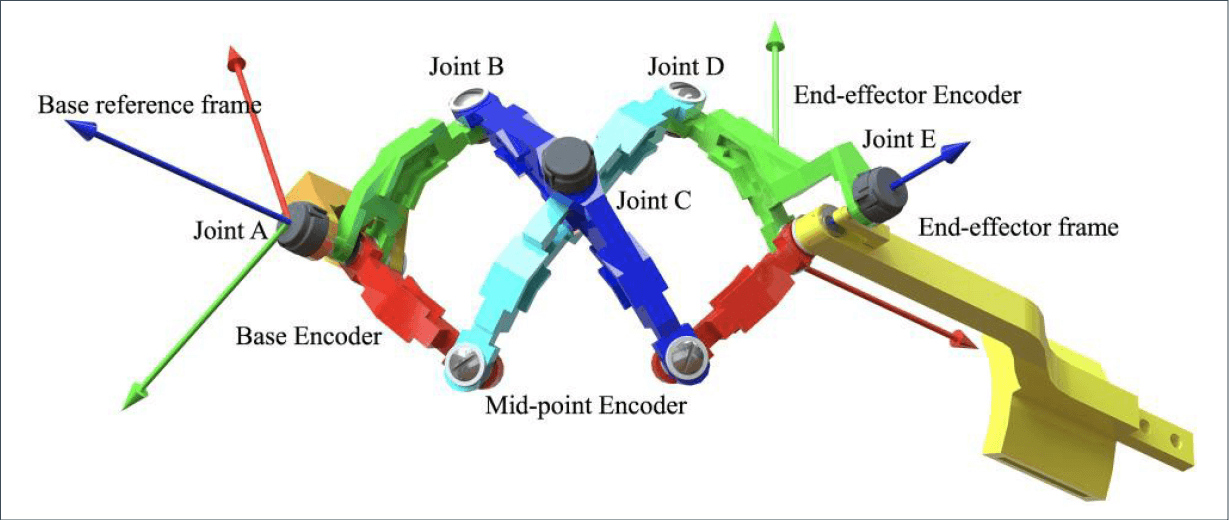
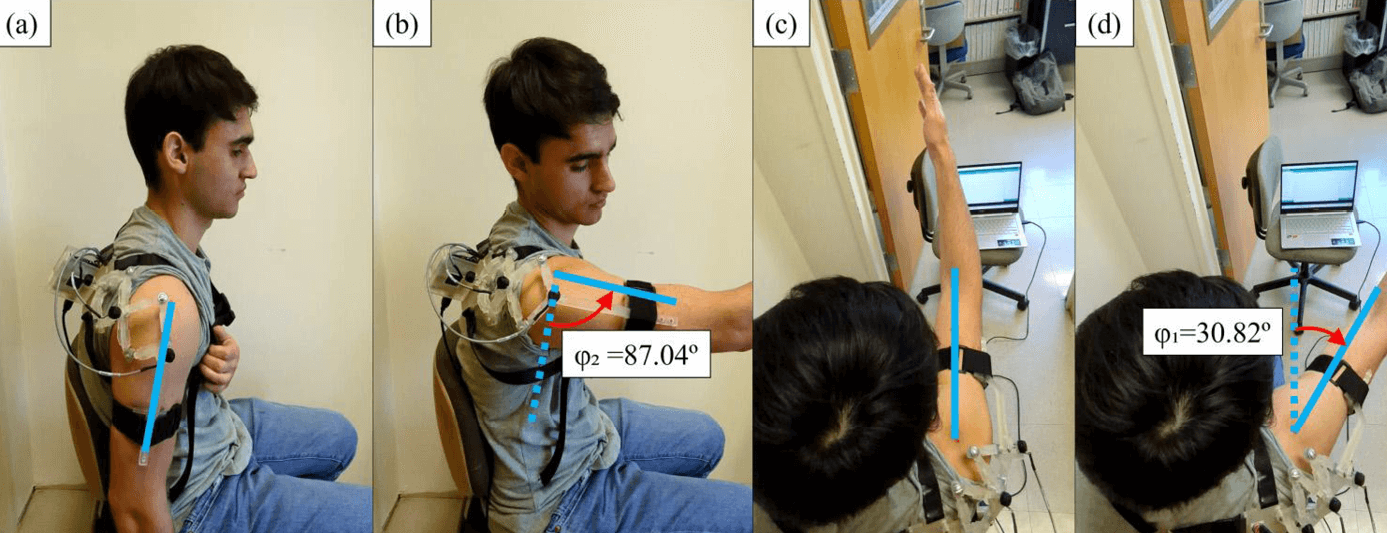
Abstract: This paper presents the design, construction, and testing of a spherical shoulder exoskeleton that measures shoulder movement for use before and after reverse total shoulder arthroplasty. The device is designed for in-home use to facilitate remote physiotherapy. Embedded sensor data are converted to a robotic shoulder model to illustrate the measured movement, and which is validated through Image measurements. Unlike current motion capture and image processing measurement techniques, this device measures the movement of the upper arm relative to the scapula, excluding scapula movement, thereby focusing on movement provided by the shoulder prosthesis.